

Introduction to MPLS Providers
In today’s fast-moving digital world, businesses depend heavily on strong and reliable communication systems. Whether it is connecting branch offices, managing cloud applications, or handling sensitive business data, everything requires a stable network. This is where MPLS providers become extremely important.
MPLS providers are companies that offer private networking solutions using a technology called Multiprotocol Label Switching (MPLS). Instead of sending data through the public internet where traffic can be unpredictable, MPLS providers create a dedicated and optimized path for business communication. This ensures that data moves quickly, safely, and without interruption between different locations.
Large organizations such as banks, multinational companies, healthcare institutions, and retail chains depend on MPLS services because even a small delay or network failure can cause serious business impact. Providers like AT&T, Verizon, and BT Group are among the leading names in this industry, offering global network coverage and enterprise-grade solutions.
What MPLS Actually Means
MPLS stands for Multiprotocol Label Switching, a method used in networking to improve how data is transferred across wide-area networks. In traditional internet systems, data travels based on IP addresses, and each router has to analyze the packet before forwarding it. This process can sometimes slow down communication, especially when traffic is heavy.
MPLS changes this process by attaching a simple label to each data packet. Instead of checking full IP information at every step, routers only read the label and forward the packet instantly along a predefined path. This reduces processing time and makes the entire system faster and more efficient.
This technology is especially useful for real-time services such as voice calls, video conferencing, and cloud-based applications. In such cases, even milliseconds of delay can affect quality, so MPLS helps maintain smooth and stable performance.
How MPLS Providers Work
MPLS providers operate by building a private network layer over their existing infrastructure. When a business subscribes to MPLS services, its offices are connected to the provider’s network through secure routers. After that, the provider manages all data routing between locations.
When data is sent from one office to another, it first enters the provider’s network where it receives a label. This label determines the best path the data should take. The routers inside the MPLS network then forward the data based on this label instead of analyzing the full packet. This makes communication faster and more predictable.
Another important aspect of MPLS providers is traffic prioritization. Not all data is treated equally. Critical applications like video meetings or financial transactions are given higher priority, while less important traffic is handled in the background. This ensures business operations run smoothly even during peak usage times.
Key MPLS Providers in the Market
The MPLS industry is dominated by several global telecom companies that provide enterprise-grade connectivity solutions. Among them, AT&T is known for its extensive international network and strong enterprise services. It supports large organizations that require connectivity across multiple continents.
Another major provider is Verizon, which is highly popular in North America. It is known for reliable network performance, strong security features, and advanced managed services for enterprise customers.
In Europe and other global regions, BT Group plays a major role. It provides secure and scalable MPLS solutions for businesses that operate across different countries and require compliance with strict data regulations.
While not a service provider in the traditional sense, Cisco Systems is also deeply involved in MPLS technology. Many MPLS networks around the world use Cisco hardware and software as the backbone of their infrastructure, making it a key technology leader in this space.
Benefits of MPLS Providers
One of the biggest advantages of MPLS providers is performance. Because data follows predefined routes instead of unpredictable internet paths, it reaches its destination faster and with lower delay. This is especially important for businesses that rely on real-time communication.
Reliability is another strong benefit. MPLS networks are less affected by congestion compared to public internet connections. Even during high traffic periods, performance remains stable and consistent.
Security is also a major reason companies choose MPLS. Since the network is private and managed by providers, data does not travel through the public internet. This reduces exposure to cyber threats and unauthorized access.
MPLS also supports traffic prioritization through Quality of Service (QoS). This means important applications always get priority over less critical ones, ensuring smooth operation for essential business tasks.
Scalability is another advantage. As businesses grow, MPLS networks can easily expand to include new branches or offices without redesigning the entire system. This makes it a long-term solution for growing enterprises.
Common Uses of MPLS Networks
MPLS technology is widely used in industries where communication reliability is critical. In the banking sector, it helps connect branches securely while ensuring fast and safe transaction processing.
Healthcare organizations use MPLS to share patient data between hospitals and clinics without delays. Retail companies rely on it to manage inventory systems and point-of-sale data in real time across multiple stores.
Government agencies also use MPLS for secure internal communication, while large enterprises depend on it to connect global offices and manage cloud-based applications efficiently.
MPLS Network Structure
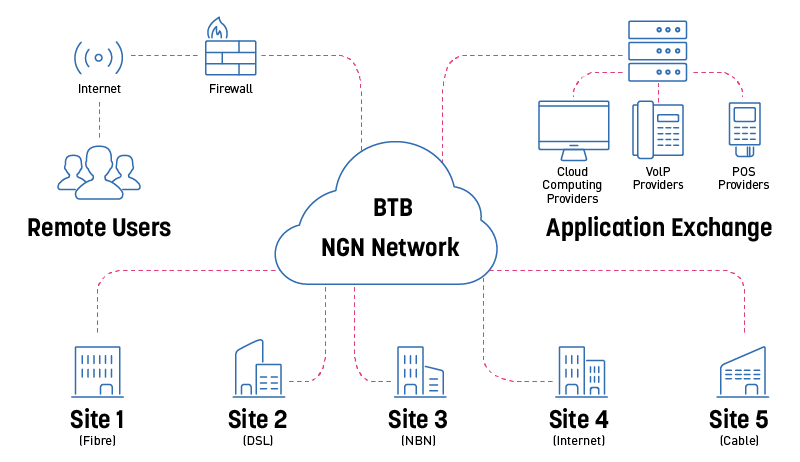
An MPLS network is built using a structured system of routers. At the business location, a Customer Edge (CE) router connects the company to the provider’s network. This router sends data into the MPLS system.
Inside the provider’s network, Provider Edge (PE) routers assign labels to the data and determine its path. Then the Provider (P) routers, which form the backbone of the network, forward the data through optimized routes until it reaches its destination.
This structured approach ensures that data flows smoothly and consistently across long distances without unnecessary delays.
MPLS vs Traditional Internet
When comparing MPLS with traditional internet connections, the differences are quite clear. The public internet is shared by millions of users, which means traffic can become unpredictable and slow at times.
MPLS, on the other hand, uses dedicated paths that are not affected by public congestion. This results in lower packet loss, reduced delay, and more stable performance. For businesses that depend on continuous communication, this difference is extremely important.
MPLS vs SD-WAN
In recent years, SD-WAN has emerged as a modern alternative to MPLS. While MPLS offers high reliability and security, it is often more expensive and less flexible. SD-WAN, on the other hand, is more cost-effective and allows businesses to use multiple internet connections.
Many companies today are adopting a hybrid model where MPLS is used for critical applications, while SD-WAN handles general traffic. This combination helps balance performance, cost, and flexibility.
Cost and Considerations
MPLS services are generally more expensive compared to regular internet solutions. The cost depends on several factors such as the number of locations, required bandwidth, geographical coverage, and service agreements.
Businesses usually choose MPLS when they need guaranteed performance and strong support, even if it comes at a higher cost.
Challenges of MPLS
Despite its advantages, MPLS also has some limitations. The most common challenge is cost, as it is significantly more expensive than other networking options. Setup and deployment can also take time, especially for large organizations with multiple locations.
Additionally, MPLS is less flexible compared to modern cloud-based solutions, which is why many companies are now shifting toward hybrid networking models.
Future of MPLS Providers
The future of MPLS is not about replacement but evolution. Many providers are integrating MPLS with cloud technologies and SD-WAN systems to create more flexible and efficient networks.
As businesses continue to rely on digital communication, MPLS will remain an important part of enterprise networking, especially for organizations that require stable and secure connections.
Conclusion
MPLS providers play a vital role in modern business communication by offering secure, reliable, and high-performance networking solutions. Even though new technologies like SD-WAN are changing the industry, MPLS continues to remain relevant for enterprises that prioritize stability and security.
Understanding how MPLS providers work helps businesses make smarter decisions about their network infrastructure and ensures they choose the right solution for long-term growth and performance.
FAQs
Q: What are MPLS providers?
A: MPLS providers are companies that offer private network services using MPLS technology to connect business locations securely and efficiently.
Q: How do MPLS providers improve network performance?
A: MPLS providers improve performance by using labeled data routing, which reduces delays and ensures faster and more stable data delivery.
Q: Why do businesses use MPLS providers?
A: Businesses use MPLS providers for secure, reliable, and high-speed communication between multiple offices and cloud systems.
Q: Are MPLS providers better than the public internet?
A: Yes, MPLS providers offer more stable, secure, and predictable performance compared to the public internet.
Q: What is the main benefit of MPLS providers?
A: The main benefit of MPLS providers is guaranteed network quality with prioritized traffic for critical business applications.
